

Kenneth Ryland     Crane Davit     Sanshin    Llewellyn Ryland     Lagun     Goiot
 
 
Anti-corrosive Jointing Compound
 Duralac    Application    Contact

...inhibits electrolytic corrosion of dissimilar metals

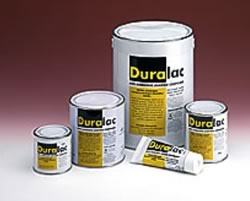
Duralac is an anti-corrosive jointing compound for use between joints of dissimilar metals.

'Duralac' Jointing Compound is a yellow paste prepared from elastic varnish of low moisture permeability, a corrosion inhibiting material, Barium Chromate, and an innert filler.

It conforms to specification DTD369B

Barium Chromate is only very slightly soluble in water and hence is not leached out of the joint even in the presence of a considerable flow of water. It is, however, readily decomposed by acids with the liberation of chromic acid so


that it is brought into action only in the presence of corrosive influences. It is tough and flexible, absorbs little water and is resiliant to sea water. top

Barium Chromate is only very slightly soluble in water and hence is not leached out of the joint even in the presence of a considerable flow of water. It is, however, readily decomposed by acids with the liberation of chromic acid so that it is brought into action only in the presence of corrosive influences. It is tough and flexible, absorbs little water and is resiliant to sea water.

'Duralac' Jointing Compound is indispensible for the sealing of joints between dissimilar metals of all
types including magnesium and its alloys. It is also valuable for the protection of metals in contact with wood, synthetic resin compositions, leather, rubber, fabrics etc.,

Where the components of a structure are of different materials it is essential that the point or faces of contact should be treated with corrosion inhibiting materials because in the presence of electrolytes considerable differences of potential arise not only where different metals are in contact, but also where components of the same metal under different stresses are in contact: such for example as between the aluminium alloy plates or extrusions and rivets or bolts used in building up the structure.

In industrial areas where structures are exposed to flu ducts and acidic vapours. In close proximity to the sea where a salt laden atmosphere will be met with, structures will need the maximum attention to prevent corrosion due to the electrolytic cells set up by the salt laden moisture deposited upon the structure. top

Application

'Duralac' is supplied ready for use and must not be thinned. It is best applied by brush. When 'Duralac' is applied to metal or other surfaces the volatile solvent evaporates and the compound sets to the touch, but remains tacky for a considerable period. It is important that the joint should be closed whilst the 'Duralac' is still tacky - that is in such a condition that it will flow sufficiently under pressure to close the gaps in the joint. It will harden somewhat if a thin film be left exposed to the atmosphere for a long period, which will prevent the making of a closed joint.

'Duralac' is available in the following types: No 1305 to specification D.T.D. 369B for flush joints and general purpose jointing. It is supplied in 250ml, 500ml, 1 litre, 2.5 litre and 5 litre cans.
No 2192 as No 1305 but a higher viscocity. Supplied in tubes.

Technical staff are available to advise upon'Duralac'applications and special requirements.

Kenneth Ryland
Charity Farm, Stanton, Nr Broadway, Worcs. WR12 7NE
Tel/Fax: 0044 (0) 1386 584 270
Mobile: 0044 (0) 7802 261 931
E-mail: kennethryland@ukonline.co.uk

top
HOME I DAVITS I SANSHIN I LR I LAGUN I GOIOT

Copyright © 2005 web design by acorn design & print